Austria is a country bursting with history, culture, wonderful scenery and a fantastic quality of life. Its capital, Vienna, regularly ranks as one of the best cities in the world to live in, whilst several other cities and towns are renowned for their welcoming hospitality, stunning views and fantastic career opportunities. However, moving to Austria is not always straightforward, and expats planning to relocate need to be aware of the challenges they may face.
In this guide, we explore visa options, job prospects, the cost of living and more to help with the smooth relocation to your new home.
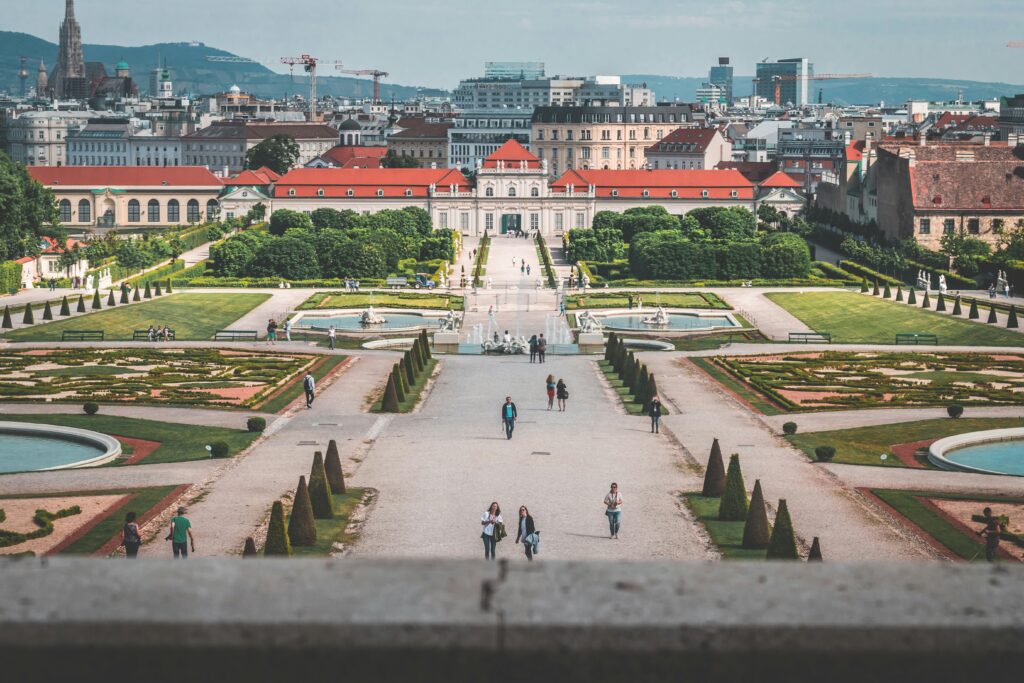
Austria at a glance
- Capital: Vienna
- Population: 9.25 million (approx)
- Currency: Euro
- Language: German
- Religion: Christianity (55%), No religion (22.4%), Islam (8.3%), Others (14.3%)
- Time zone: GMT+1
- Driving side: Right
Popular areas of Austria
If moving to Austria is still just an idea rather than a reality, you may want to weigh up the areas best suited to you, your family, your occupation or your plans. Austria has plenty to offer expats. From the cultural sights and sounds of Vienna to the alpine settings of Salzburg, there are options for all lifestyles.
Popular areas in Austria for families
If you are moving to Austria with your family, you are spoilt for choice with great places you could call home. Vienna is home to excellent public and international schools and is known for its safety and cleanliness. Graz is another fantastic choice for families. Its smaller size makes it a more manageable city, and like Vienna, it has a great network of schools and an abundance of green space. Linz is also a great place to base your family with cheaper housing and a solid job market, especially in tech and industry.
Popular areas in Austria for digital nomads.
Many expats use Austria as a base when working remotely, and it’s easy to see why. Vienna is home to a large international community, allowing for great networking opportunities. In Graz, the startup scene is growing rapidly and could see you transition from nomad to permanent resident in a developing area. With remote work making your office move with you, Innsbruck remains a great choice. The café culture and abundance of scenic spots make work more relaxing than challenging.
Popular areas in Austria for retiring expats
If you are moving to Austria, perhaps as a retiree, the best places to start are the larger cities. Vienna is home to the largest expat community in Austria, and English is widely spoken. Salzburg is a popular destination for international tourism and has a strong business presence, whereas Innsbruck has a strong international population, and residents enjoy a high quality of life.
Areas to avoid in Austria
Even though Austria offers expats some incredible places to live that fuse culture, scenery, wellbeing and opportunity, some may not be best suited to expats. Rural alpine areas such as Tyrol, Vorarlberg and Styria may offer stunning views, but language barriers, minimal job opportunities and limited educational services present challenges.


Austria visa requirements
Moving to Austria does require a visa, but various criteria apply depending on how long you plan to stay and your country of origin. Those from the EU/EEA or Switzerland, can enter Austria without a visa and live, work, study, or start a business there. However, if the stay exceeds three months, they’ll need to register their residence with the local authorities. Once there have been more than 5 years of continuous residence, an application for permanent residence can be made.
For non-EU/EEA or Swiss nationals, the criteria are different. They can stay in Austria for up to 90 days without a visa, but if the stay is long-term (more than 6 months), an application for a residence permit must be submitted before arrival.
Austria visa options
There are several visas you can apply for if moving to Austria. Your circumstances determine which one you should apply for:
- Red-White-Red Card: The most common visa. Specifically for highly qualified workers, skilled workers in shortage occupations, self-employed key workers and graduates of Austrian universities. These cost €218 and eligibility is determined on a points system. Last for two years and tied to just one employer.
- Blue Card: For expats who earn a salary of at least 1.5 times the Austrian gross annual salary. Specifically aimed at highly qualified workers with a degree. Approximate cost of € Lasts for two years and can be extended if the work contract is renewed.
- Jobseeker visa: A 6-month visa that allows you to remain in Austria while looking for work. Approximate cost of €
- Student visa: A visa specifically for those enrolled in Austrian education. Approximate cost of €
Apply via the Austrian Embassy, ensuring you have proof of health insurance, a job offer, accommodation, sufficient funds to support yourself and a clean criminal record.
Registering residency in Austria
Once you arrive in Austria, you are legally obliged to register your residence. This must be done within three days of arrival. This is done at the municipal office or registration office in your place of residence. Complete the Meldezettel and bring your passport and proof of accommodation. You will then be granted a Meldebestätigung, which is used when opening bank accounts, buying a house and more.
Temporary and permanent residency visas in Austria
Holders of an RWR or Blue Card are granted temporary residency in Austria, but permanent residency can be applied for after you have lived in the country for five years. After five years of continuous residence, citizenship can then be applied for. Specific requirements must be met for permanent residency, including proof of financial self-sufficiency, proof of your German language skills and a guarantee that you pose no danger to public peace or national security.
Job opportunities in Austria
Austria presents multiple job opportunities to expats. Construction, tourism, electronics, food, transportation and textiles are all areas key to the country’s economic stability. As an expat, you will likely hold an RWR or Blue Card, and these are tied to employment or earnings. With an RWR or blue card, you have the right as an expat to work in Austria, but it must be noted that with the RWR card, you are tied to your employer for two years. If you were to leave and start working elsewhere, you’d have to apply for a new RWR card.
There is currently no statutory minimum wage in Austria, but the more than 800 collective agreements within occupational groups or sectors ensure that 95% of employees are protected by a minimum wage determined by their employment sector.

Tax in Austria
You’ll have to pay tax in Austria, and like other countries, the amount you pay depends on your earnings. Low earners (less than €13,539) pay no tax on their earnings, with the rate rising gradually. Once the salary exceeds €1 million, the top rate of 55% applies. Your employer will also deduct social security contributions, which cover insurance for health, pension, unemployment and accidents. This amounts to approximately 17% of your gross income, with a further 23% covered by your employer. Austria is currently in the top five for European countries with the highest income tax rates.

Banks in Austria
Expats in Austria can find opening a bank account challenging. Many banks limit their services to Austrian nationals or those with residency. However, there are numerous banks open to everyone. Before leaving for Austria, it may be advisable to search online for various banks’ eligibility criteria, so that you can open an account with one that suits your needs and residency status.
To open a bank account in Austria, you will need:
- Passport
- Proof of your address
- Reason for opening the account
- Proof of income or employment
Common banks found in Austria include Dadat, Erste and DKB.
Cash rather than card also remains preferable in Austria. A 2025 survey found that Austria ranks among the bottom 5 countries for cashless payments. Therefore, it is advisable to keep some cash for daily expenses so you don’t get caught out.
Cost of living in Austria
Austria has a moderate cost of living compared to many other European countries. It is generally cheaper than neighbouring Switzerland but more expensive than Italy, France, Spain or the UK. That being said, rental prices in the UK are significantly higher than they are in Austria.
Wages in Austria
There is no set minimum wage in Austria, but based on collective agreements that ensure 95% of employees receive at least €1,700 in gross earnings 14 times a year, the average monthly wage in Austria is €1,983 compared to €2,935 in the UK.
Property prices in Austria
Property in Austria is generally more expensive than it is elsewhere in Europe. Switzerland and Luxembourg aside. Property prices are typically similar to those found in the UK, but places such as London do tend to be significantly more expensive than Vienna.
You can expect to pay €300,000-€380,000 for a typical house in Austria, but this widely depends on location. Cities like Vienna and the Alpine regions are among the most expensive, whereas rural and less central parts of the country will see cheaper house prices and lower rents.
Utility prices in Austria
Utilities in Austria are, on average, more expensive than in the UK, Germany, France and many other European countries. The estimated monthly costs for electricity, water, gas and refuse collection are just over €300 for a standard apartment.

Austria public transport
The public transport system in Austria is an effective and safe way to get around. Serving the cities and smaller areas, the trams, buses, metro and trains enable expats to navigate their way from place to place easily. Costs are relatively low, with a monthly travel pass in Vienna costing just €75.00. This allows for travel via multiple methods without the need for additional tickets. A further cost saving, especially for those who venture further afield, is the KlimaTicket Ö. This is a nationwide annual ticket for use on almost all public transport, as well as regional and intercity trains. For the cost of just €1,400, you’ll benefit from unlimited travel. There are also regional versions of this ticket costing much less and providing travel within a federal state.
Childcare costs in Austria
Childcare in Austria is incredibly affordable when compared to many other countries, especially the UK. In fact, the fees involved are typically among the lowest in Europe, with less than 5% of household income going towards childcare expenses. The system is largely subsidised and publicly funded, allowing the household budget to go much further. In many cases, the only or main expense is for meals or additional services.

Living expenses in Austria
Using the latest Numbeo data, we’ve highlighted common expenses in Austria and compared them in the UK.
| Item | Cost in Austria | Cost in the UK |
| Monthly utility bills | €327.26 | €276.49 |
| Monthly childcare | €378.63 | €1480.25 |
| Monthly Rent (1 bed city centre) | €870.52 | €1,170.36 |
| Standard mobile phone plan | €14.12 | €15.28 |
| Monthly broadband | €31.87 | €36.95 |
Buying or renting property in Austria
Moving to Austria means you’ll need a property to call home. Whether renting or buying, expats should be aware of the potential challenges they may face. Thankfully, there aren’t many, and the Austrian housing market is quite easy for expats to navigate.
Renting property in Austria as an expat
One of the first things to know if you plan to rent in Austria is that most rental properties are unfurnished. This means you’ll need to plan the transportation of your belongings from the UK to Austria or purchase everything upon arrival. Fully serviced rental properties are available, but the rents can be very high.
Rental leases normally last for three years, but short-term leases are available; however, these tend not to be your typical rental property.
You can visit an estate agent in Austria either in person or online and organise viewings, which are always free of charge. Upon finding the property you want, you’ll need to supply proof of identity, income and employment as well as your Austrian visa. Deposits are normally three months’ rent, but can be as high as six.
Buying property in Austria as a foreigner
If you are deciding to buy a property in Austria as an expat, how you proceed depends on whether you are an EU or non-EU citizen.
If you are from an EU country, you can buy a property just like you would back home. However, some provinces will prohibit it if the home is not your permanent residence. For non-EU nationals, you may be required to supply a special permit from the Land Transfer Authority before you can buy.
Once you have found a property you would like to buy, make an offer in writing to the estate agent. With this should be the Kostenaufstellung. This is a list documenting all transaction costs such as legal fees, property tax, notary fee and estate agent fees. Once the offer is accepted, an Austrian solicitor draws up the contract and a deposit is paid. Ownership is then registered, with registration costs paid to complete the transaction.

Austria Healthcare system
The healthcare system in Austria provides access to both public and private healthcare. Known for their high standards and affordability, expats benefit from excellent levels of care. To make use of it, you’ll either need a private health insurance plan or be contributing to the public system through your social security deductions. In most cases, you’ll be automatically enrolled in the public system; however, holders of certain visas or the self-employed may need to organise contributions directly with the relevant authorities or source a comprehensive private plan for sufficient coverage.
It’s important to understand that healthcare is not free in Austria, but with substantial funding from social security contributions, most services are either free or heavily subsidised at the point of use. Small co-payments do apply in some instances, such as for prescriptions, dental care or specialist procedures. Expats are reminded of the potential language barriers they may face in healthcare settings and the importance of private healthcare for premium care.

Austria schools
Austria has a high-quality education system that is well-regarded across Europe. Schooling is compulsory for 9 years, with primary school starting at 6 years old. The time at Volksschule lasts four years, whereafter the children move to a general secondary school (Mittelschule) or an academic secondary school known as an Allgemeinbildende. From the age of 17, higher education at a university is available, and from 18, an advanced college course can be taken if a job can be held down at the same time. The school year in Austria runs from early September to late June/early July.
For expats, the largest challenge remains the language. In Austrian public schools, teaching is primarily in German; however, many schools, especially in Graz, Vienna or Salzburg, offer language assistance to support integration.
International schools in Austria, as well as private schools, are also an option for expat children. English is widely spoken, making it much easier for children living in a new environment. Vienna International School, American International School Vienna and Graz International Bilingual School are just some of the globally recognised establishments.
Registering for school should take place in autumn or winter before the start of the school year. This includes visiting the school in person, where a school director will determine whether the child is ready to attend. Public schools in Austria are free; however, fees apply for private or international establishments.

Is Austria a safe place to live?
Austria is considered a very safe country and ranked 4th on the 2025 Global Peace Index. However, popular tourist areas, major train stations and city centres are prone to pickpockets and bag snatches. Expats are advised to take care of their personal belongings and keep items secure when on public transport or in crowded places.
If you are the victim of a crime, you should call 112 for emergency services, or 133 specifically for the police, 144 for ambulances and 122 for fire. Many call handlers will speak English, but learning some key German phrases is advised to help you get the best possible support in an emergency.

Common challenges encountered by expats in Austria
Moving to a new country isn’t just about securing the correct visa, job or property. It’s also about integration. Expats, therefore, need to be aware of potential challenges they may face.
Language in Austria
German is the main language in Germany, and whilst larger cities such as Salzburg, Linz, or Vienna may see high numbers of English-speaking people. This is less prominent in rural areas and smaller towns, where regional dialects may be common.
Cultural differences
Privacy and punctuality are highly valued in Austria. Being just 5 minutes late can be seen as disrespectful, and asking personal questions early on in a relationship is frowned upon. You may also find that Austrians are direct and honest without being overly expressive. This can make social circles often hard to break into. The sense of humour is often dry or ironic and can sometimes be hard for newcomers to grasp.
Etiquette to be aware of
Austrian etiquette is subtle but important, and things you see as minor indiscretions can make a huge impact on how you are perceived.
Always greet people when entering small shops or waiting rooms. “Guten Tag” is sufficient. People should always be addressed formally, too. Using “sie”(formal) rather than “du”(informal) can make a big difference.
Quiet hours, known as Ruhezeiten, are typically in the evenings, on Sundays and during public holidays. This is taken very seriously, especially in apartment buildings.
Conversations should also steer towards safe subjects when building relationships. Travel, food, sport and culture are all safe bets, but politics, personal income and WWII history should be approached with caution.
Work-life balance
Austria offers an exceptional work-life balance with 25 days of paid holiday and an additional 13 public holidays. A typical working week is 38-40 hours. Generous parental leave policies are also in place, allowing parents to receive up to 80% of their income for up to 14 months. Additionally, labour laws mandate 13th and 14th salary payments known as holiday and Christmas bonuses. Many companies also provide a wide range of benefits to support employee wellbeing.
Weather in Austria
Austria is synonymous with snow-capped mountains and skiing, but not all of the country basks in alpine surroundings. The warm summer weather across the lowlands is known to trigger thunderstorms, whilst the winter season remains cold and wet with frequent showers, low cloud and fog.
| Month | Jan | Feb | Mar | Apr | May | Jun | Jul | Aug | Sep | Oct | Nov | Dec |
| Avg max Temp (c) | 2 | 4 | 10 | 16 | 20 | 23 | 26 | 25 | 21 | 15 | 8 | 3 |
| Sunlight (hrs) | 2 | 3 | 4 | 6 | 7 | 7 | 8 | 7 | 6 | 4 | 2 | 2 |
Public Holidays in Austria
For 2026, the public holidays in Austria are:
- 1st January (Neujahr)
- 6th January (Heilige Drei Könige)
- 6th April (Ostermontag)
- 1st May (Staatsfeiertag)
- 14th May (Himmelfahrt)
- 25th May (Pfingstmontag)
- 4th June (Fronleichnam)
- 15th August (Mariä Himmelfahrt)
- 26th October (Nationalfeiertag)
- 1st November (Allerheiligen)
- 8th December (Mariä Empfängnis)
- 25th December (Chrisstag)
- 26th December (Stefanitag)
Useful resources for expats
- Austrian Ministry of the Interior https://www.bmi.gv.aut
- Austrian Immigration Department: https://migration.gv.at/en
- Austrian Federal Ministry of Education: https://www.bmbwf.gv.at
- International School Directory of Austria: https://www.international-schools-database.com
- Expat forums for advice and support