Japan is widely recognised as a country with one of the best health systems in the world. With high-quality medical care provided through universal coverage, residents, citizens and expats can all benefit from the comprehensive public health system. Across the country, healthcare is of a high standard with a focus on prevention rather than reaction.
The healthcare system in Japan is different to many others in the world, so for expats it is essential to understand it, how to access it and what limitations there may be.
Public healthcare in Japan
The public healthcare system in Japan, known as Social Health Insurance or Shakai Hoken (SHI), is available to all residents and citizens, including expats who work full-time. Those who are self-employed, work part-time or are not covered by SHI are instead covered by the National Health Insurance or Kokumin Kenko Hoken (NHI). Both are funded through government subsidies, premium contributions and co-payments. They offer all eligible residents a wide range of services, including emergency care and surgeries at subsidised rates. For households earning below a certain threshold, a public assistance programme is available, exempting the household from insurance or public healthcare payments.
The quality of care within the Japanese public healthcare sector is very good, and unlike many other countries, the universal coverage extends to dental and optical care. Facilities are of a high standard, but expats may encounter language barriers, especially outside major cities.
Enrollment in the public system is mandatory for eligible residents and ensures that 70% of medical expenses are covered for most treatments, including doctor visits, hospital stays, surgery and some preventative care. The remaining 30% is then covered out of pocket or via a private health insurance plan. How you enroll depends on whether you are eligible for NHI or SHI. The SHI scheme, also referred to as an EHI or employment-based health insurance, will normally be handled by your employer the moment you start work. You can also register your dependents for coverage with the same scheme.
It gets a little more complicated if you qualify for NHI. You’ll need to register at your local municipal office within two weeks of arriving in Japan and bring:
- Valid ID and residence card or visa.
- Proof of address
- Your Japanese social security number (obtained after registering as a resident)
- Proof of earnings
After enrolling, you’ll receive a Hoken Sho (health insurance card), which must be taken to all appointments.
Does Japan have free healthcare?
Healthcare in Japan is not free, but it is heavily subsidised. The national health insurance system covers around 70% of most medical costs, with patients paying the remaining 30% out of pocket or through supplementary insurance. This scheme is only available to citizens and eligible residents, including expats staying longer than three months. Those visiting for shorter periods must take out private health insurance (minkan iryo hoken) to access medical services. In some cases, reciprocal healthcare agreements may allow short-term visitors limited access to the public system.
To keep healthcare affordable, the Japanese government regulates medical fees, caps copayments, and offers discounts for low-income earners. The level of support varies by prefecture and considers factors such as age, income, and location. Importantly, high-cost caps limit how much patients pay in a given month. If these limits are reached, individuals can apply for additional high-cost medical benefits, further reducing expenses.
For expats living in Japan, private health insurance is strongly recommended. It helps bridge the gap between statutory cover and actual medical costs, while also offering access to quicker treatment, more comfortable facilities, and extra services such as mental healthcare, specialist care, and cosmetic procedures.
Does Japan have free healthcare?
Private healthcare in Japan
Private healthcare in Japan is somewhat different to the private healthcare found in many other countries. The majority of healthcare providers in Japan operate as private sector businesses but remain accessible through the public system. Figures indicate that approximately 70% of hospitals in Japan are private, with the rest being public sector or non-profit.
Private healthcare facilities in Japan are, in fact, small, often family-run organisations offering routine care with just some specialities. Equipment is normally of industry standard, and the level of care quality is good. The facilities that mirror “private” as we view it in the UK and the USA, for example, are in fact found in International Hospitals. Many of these also operate as part of the national system, where 70% of costs are covered. However, some smaller international facilities do not participate in the public insurance scheme and therefore require patients to pay for treatment themselves or use a private health insurance plan.
Due to the public sector covering such a wide range of treatments, the unique treatments offered by the private sector in Japan are fewer than those found elsewhere. That being said, specialist treatments, mental health support, some optical and dental care and cosmetic surgeries are often only found in private facilities.
The costs of private healthcare in Japan can vary, but thanks to government regulation, they are heavily monitored. A visit to a clinic can cost approximately ¥5,000 to ¥10,000 (£25/$35 to £50/$68) with insurance, whilst a visit to the emergency room could cost around three times this amount. Long-term hospital stays cost considerably more, and in some cases, reservation charges may be applied. Should a stay at an international hospital be required, the costs can be even higher and may not be covered with public insurance.
Japan is home to some high-quality private hospitals, including the JCI-accredited St Luke’s International Hospital and the NTT Medical Centre. Both are in Tokyo and provide English-speaking patient support and a wide range of services. Outside of Tokyo, Nagoya University Hospital and Kyoto University Hospital cater to international patients.
Private healthcare is recommended for expats in Japan, even if eligible for the public healthcare system. With only 70% of medical expenses covered, the insurance bridges the gap and ensures little to no out-of-pocket expense.


Health insurance for expats in Japan
Health insurance is mandatory for expats living in Japan. This contribution is made through deductions from the salary (approximately 5% with the same amount matched by the employer). If you are on NHI, the deduction is based on your income. With only a percentage of medical expenses covered, a private health insurance plan ensures you can cover any outstanding amounts and access high-quality care without the added financial stress.
Expats must enrol in the public system once they are registered as Japanese residents and can top it up with supplemental private coverage if they prefer. There is no obligation to do this, but for many, it offers an extra degree of coverage and more suitable facilities. Before being granted residency, a standalone private healthcare plan will be required. A local plan is often chosen in the interim, but it limits coverage to Japan only, and for some expats, this isn’t sufficient. As a result, international plans are the most popular option. They cost a little more than local plans but offer more comprehensive coverage and allow for repatriation or overseas care if required.
Exclusions often apply to private plans. These could range from pre-existing conditions to cosmetic treatments, but as each policy can differ, it is worth checking before taking out a plan. Premiums for a private plan in Japan can vary significantly, and take into account your age, medical history, level of coverage and the insurer. Basic coverage, used to fill the 30% co-pay, can cost between ¥3,000 and ¥5,000 per month, whereas an international plan offering direct billing, no co-pays and global coverage could cost as much as ¥40,000 per month.
Pharmacies and medication in Japan
Pharmacies in Japan, known as Yakkyoku, can be found throughout Japan. They fill prescriptions, give healthcare advice, and sell over-the-counter medicines like antihistamines, antacids and decongestants. Prescription medications are heavily regulated in Japan by the PDMA, but at last count, there were approximately 16,000 licensed drugs on the market.
You’ll need to present your prescription to the pharmacist to have it filled, but you only have four days from the date of issue to do this. If you miss this window, you’ll need to revisit the GP and be prescribed the treatment again.
Medication costs are capped similarly to hospital treatments and are discounted through the statutory insurance scheme. This means that in most cases, only the 30% co-pay is expected. Compared to the USA and Europe, medication costs in Japan are relatively low, although many OTC products can appear more expensive.
Pharmacies and medication in Japan

Hospitals in Japan
Private vs public hospitals
Japan has an abundance of public and private hospitals, with, perhaps surprisingly, more private facilities than public. Only 30% of hospitals are publicly owned or run as not-for-profit organisations. The standards in both are high, but private facilities are actually the opposite of what you see in many other countries. Instead, they are small, often family-run facilities offering routine care rather than hotel-like suites and enhanced standards of care.
Public hospitals, on the other hand, are fewer in number but offer advanced levels of care and are often seen as the “last stop” for complex or emergency cases. Equipped with cutting-edge technology, bilingual staff and more beds, these facilities are the benchmark for Japanese healthcare. That being said, wait times can be long, so expats will often look to international hospitals instead. These offer enhanced levels of comfort, short wait times and are more aligned with matching the general expectations of private hospitals.
Hospitals in Japan
Quality of hospitals in Japan
The quality of hospitals across Japan is generally good, especially in the public sector. Many public and international private hospitals hold JCI or JMIP accreditation. The NTT Medical Centre in Tokyo and St Luke’s International both hold the prestigious JCI endorsement, whereas Hiroo Hospital, a well-known public facility, holds JMIP accreditation and is celebrated for its multilingual staff alongside its high standards of care.
English-speaking staff in Japanese hospitals
English-speaking staff can be found in many Japanese public and international hospitals. Private facilities may have fewer English-speaking staff, and in clinics, it can be even rarer. Much will depend on the location of the private hospital or clinic. Those located in areas popular with expats are likely to have some English-speaking staff, but this is not a guarantee.
Top hospitals in major cities
Across all major cities in Japan, you can find many excellent public and private hospitals. Tokyo, Kyoto, Nagoya and Aichi, among others, are all home to well-known and well-respected hospitals.
Services offered in hospitals in Japan
The services offered in Japanese hospitals are wide-ranging. Public hospitals offer the most comprehensive services, along with private international facilities. Clinics and private hospitals, on the other hand, are much more limited. The public hospitals offer many specialist treatments such as cardiology, oncology and orthopaedics, whereas private facilities offer more general care with limited specialisms available.
In Japan, not all medical facilities provide emergency care; however, you will find emergency medical centres within large private and public hospitals. In some smaller hospitals and clinics, emergency services are sometimes available, but only during working hours.
Hospital admission process
The admissions process in Japan varies depending on the facility required. Clinics, which are often the first point of care for many, will accept walk-ins and appointments. Upon assessment, they may refer you to a hospital, although this isn’t strictly required, as patients can choose any hospital that accepts NHI. Some facilities may require referral, and if a patient attends without one, a fee of up to ¥11,000 may be added to their hospital fees.
Costs of healthcare in Japanese hospitals
Costs of healthcare in Japanese hospitals are set by the Ministry of Health, Labour and Welfare through a fee schedule known as Shinryō hōshū tensūhyō. This means that prices in both public and private hospitals are the same, unless using an international facility that may be outside the national insurance system. The costs for a basic doctor’s appointment can cost ¥5,000 to ¥6,000, and a hospital stay can cost up to ¥50,000. With 70% covered by the national insurance scheme, the remaining 30% is covered by you or a private health insurance plan.
What should be noted is that room upgrades are not covered by insurance and need full payment from the patient.
Facilities and comfort
Facilities are generally excellent in public facilities and international hospitals. Private hospitals tend to be small with a limited number of beds. For expats wanting similar facilities and comfort to what they may have experienced elsewhere, an international hospital may be preferable. With private rooms and added features such as a bath, shower, and sofa, they provide a higher level of comfort and are perhaps more in line with expectations. Most large public hospitals also provide rooms like this, but upgrading comes at a cost to the patient that cannot be covered by insurance.
Healthcare insurance acceptance
Many hospitals in Japan accept private international health insurance, but this is not universal. In most cases, payments are made upfront with reimbursement claimed afterwards. A few hospitals and clinics offer direct billing, but this should be checked in advance.
Japan emergency services
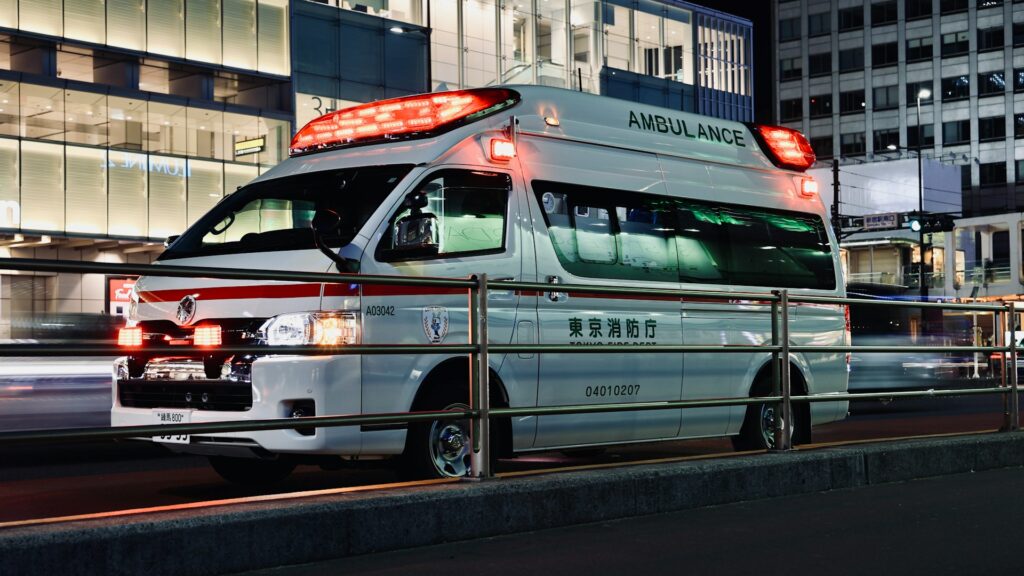
In Japan, expats can call 119 for an ambulance and 110 for police support. In addition, JNTO operates a 24-hour hotline that provides support in English and other languages. To access this, call 050-3816-2787.
Response times are quick, and paramedics are well-trained to assist with a variety of emergencies. Crews must locate a hospital that can accept you, and in busy areas, this can slow the process down.
It is recommended that expats keep ID, address details (in Japanese), insurance card and any medical information readily available in case of emergencies.
Japan emergency services
Vaccinations in Japan
Before travelling to Japan, expats are recommended to ensure all routine vaccinations, such as MMR and DTP, are up to date. Hepatitis B and Japanese Encephalitis vaccinations may also be advised, especially for those staying in rural areas.
Approximately 6-8 weeks before travel, you should consult your GP for the latest guidance and follow their advice on vaccinations and general healthcare in Japan.
Common health risks in Japan
Japan is a very healthy country, but some risks remain. Some areas of the country can get exceptionally hot during the summer months, leading to potential dehydration, heatstroke and sunburn. Seasonal influenza and cedar-pollen allergies are common, and, whilst rare, Dengue outbreaks are possible.
Expats should reduce their exposure to the sun and use protective measures to reduce the harmful effects of UV rays. Furthermore, insect repellent and long sleeves are recommended to help reduce the risk of mosquito bites.
Tips for staying healthy in Japan
Staying healthy in Japan is easy if you follow the correct guidance and apply a degree of common sense. We’ve listed some worthwhile tips below:
- Stay hydrated during the summer months and protect yourself from prolonged sun exposure. Wear sunscreen, sunglasses and a hat and always carry bottled water with you.
- Remain aware of air pollution; large cities such as Tokyo can see poor levels of air quality, often triggering allergies or exacerbating other health conditions.
- Register with SHI/NHI as soon as possible.
- Always use a clinic first for non-urgent care.
- Keep a first aid kit at home and in your car
- Stay up to date with your vaccinations and follow local health advice.
Tips for staying healthy in Japan
Useful resources
- Emergency number for ambulance: 119
- JNTO hotline: 050-3816-2787
- Pharmaceuticals and Medical Devices Agency (PMDA): https://www.pmda.go.jp/english/
- Japanese Ministry of Health, Labour and Welfare: https://www.mhlw.go.jp/english/
- Japan expat forums for community advice: