Health Insurance Germany
Our expat guide to the healthcare system and health insurance in Germany

The healthcare system in Germany offers a mix of both public and private care, and both are widely recognised for their high standards. Everyone living in Germany is required to have health insurance, and unlike in many countries where healthcare is funded through taxes, the system here works a little differently.
That’s why, for expats, having a clear understanding of how it all works is essential. This guide will help you navigate the German healthcare system so you can access the best possible care.
Public healthcare in Germany
Public healthcare in Germany is available to everyone who lives here legally, and one of the key differences from other countries is that health insurance is mandatory. Regardless of your age or employment status, you’re expected to contribute to the system through regular payments.
These contributions give you access to a wide range of services, including doctors’ appointments, hospital treatment, physiotherapy and more. Expats can benefit from this system, but depending on your employment status, citizenship, and income level, an international health insurance policy might be more suitable initially.
The quality of care in the public healthcare system is generally very good. However, reports in recent years suggest that some patients are not fully satisfied, especially due to longer wait times caused by significant staff shortages – in 2023 alone, there were around 23,000 vacancies in the health sector.
To register for public healthcare, you need to sign up with a statutory health insurance provider (there are 94 to choose from). To do this, you’ll need to provide a valid ID, proof of address, your bank details, and—depending on your situation—employment or pension documents, or an unemployment benefit notice.
Is healthcare in Germany free?

As long as you’re enrolled in public health insurance (gesetzliche Krankenversicherung or GKV), most basic healthcare services are covered. This includes GP appointments, standard treatments, prescription medication and mental health care. While you won’t pay at the point of use for many services, you might be required to pay small co-payments. For example, prescription medications typically have a co-pay of up to €10.
For people not eligible for public insurance or can’t afford a private policy, Germany offers a basic private plan called the Basistarif. This caps monthly premiums at the same level as the maximum GKV contribution and ensures access to care regardless of your income or status.
Expats can access public healthcare too, but you may need to wait until you’re eligible. For example, if you’re moving to Germany for a job, your employer will usually enrol you in health insurance from the day your contract begins. This means you’ll need to arrange interim coverage, such as an expat health insurance policy, for any gap between your arrival and your employment start date.
Private healthcare in Germany
Private healthcare is another option for expats in Germany. It often provides quicker access to services, shorter wait times, and a higher level of personal attention. Many private hospitals have bilingual staff, state-of-the-art equipment, and focus on specialist treatments.
You may need private health insurance if:
- You earn over €73,800 per year
- You’re self-employed
- You’re a student over 30
- You’re enrolled in a preparatory or language course
Private hospitals are typically smaller than public ones but offer greater comfort and more personalised care. They also tend to have better staffing levels and more efficient service overall.
Costs in the private system vary based on the treatment and your insurance coverage. To give you an idea:
- A consultation might cost between €80 and €250
- An MRI scan could cost €600 to €800
Some of the top private hospitals in Germany include the Schön Klinik network, Helios Hospital Berlin-Buch, and Beta Klinik.
While private healthcare is often recommended for expats—especially those with international insurance—it’s worth remembering that if you earn less than €73,800 annually, you’ll be required to join the public system. You can still top up your public coverage with a private supplemental plan if you’d like.



Health insurance in Germany for expats
Having health insurance is mandatory in Germany, no matter your residency status. Expats must be covered either through the public insurance system (GKV) or through a private one (PKV). The type of insurance you’re eligible for depends on several factors.
Public health insurance (GKV)
You’re usually eligible for GKV if:
- You earn less than €73,800 per year and work for a German company
- You’re an international student under the age of 30
- You’re doing an internship or apprenticeship
In most cases, your employer will automatically register you with a public insurer, and the cost of insurance will be deducted from your wages each month. Contributions are based on your income, currently set at 14.6% of your salary, plus a supplementary contribution of around 1.6%. Your employer pays half, and the other half is taken from your pay.
If your spouse or children don’t earn an income or earn very little, they can usually be added to your policy free of charge under family insurance.
Private health insurance (PKV)
You may be eligible for private insurance if:
- You earn more than €73,800 per year
- You’re self-employed
- You’re a student over 30
- You’re in a preparatory or language course
Unlike with public insurance, private plans are not automatically arranged—you’ll need to sort this out yourself. Costs vary depending on your age, health, and level of coverage, but monthly premiums usually fall between €250 and €1,000 or more.
If you’re not eligible for either GKV or PKV when you arrive, you’ll need temporary expat insurance or may be able to use a GHIC/EHIC card if you’re coming from the UK or EU, although that’s only suitable for short-term stays.
Pharmacies and medication in Germany

Pharmacies in Germany are called Apotheken and are easily recognised by the big red “A” on their signs. Don’t confuse them with Drogerien (like dm or Rossmann), which are more like general drugstores and don’t sell prescription medications.
Most pharmacies are open Monday to Friday from 9am to 6pm and Saturdays until 1pm. They’re closed on Sundays, although each area has an emergency pharmacy on rotation that opens 24/7.
Medication in Germany is tightly regulated. Many drugs you can buy over the counter elsewhere—like antibiotics or even certain painkillers—are only available with a prescription. Even non-prescription medications are usually kept behind the counter, and you’ll be asked about your symptoms before the pharmacist gives you anything.
Medicine in Germany can be quite expensive compared to other countries. If you have GKV, most prescription medication is covered, but you’ll still pay a small co-payment (usually €5–€10). With private insurance, you’ll typically pay upfront and claim the costs back later. Non-prescription items are paid for entirely out-of-pocket.
Hospitals in Germany

Public vs private Hospitals
Public hospitals are found across all towns and cities and offer high-quality care, especially in emergencies. However, due to ongoing staff shortages, they can feel overcrowded and the care may feel rushed at times.
Private hospitals, on the other hand, focus more on patient comfort and offer faster, more personalised care. While they tend to be smaller, they are well-organised and better staffed. Many also offer private rooms and other amenities that make the experience feel more like a hotel stay.
Quality of hospitals in Germany
Germany is well known for its clean, well-equipped and well-staffed hospitals. Whether you’re in the public or private system, you’ll benefit from high standards and expert care. Some hospitals are internationally accredited, such as Helios Emil von Behring, which is certified by JCI, the German Cancer Society, and more.
English-speaking staff in German hospitals
English is widely spoken in Germany, with around 56% of people having some level of fluency. That said, you may still encounter doctors or hospital staff who speak only German. But don’t worry, hospitals are legally required to make sure all patients can communicate effectively. In some cases, this means hiring an interpreter, though the cost of this might fall to you.
The Best hospitals in Germany
Germany is home to several top hospitals, especially in major cities like Berlin, Munich, Dresden and Freiburg. Charité – Universitätsmedizin Berlin is known for treating high-profile patients, and Klinikum der Universität München is a leading centre for organ transplants and academic medicine.
Services offered in German hospitals
Public hospitals cover a broad range of services including emergency care, rehabilitation, surgery and illness treatment. Some specialised treatments may only be available at specific facilities. Private hospitals often offer more tailored treatments and services not covered by public insurance.
Hospital admission process in Germany
In emergencies, you can go directly to either a public or private hospital, or call an ambulance on 112. For non-urgent treatment, you’ll usually need a referral from a GP.
Make sure you take your health insurance card, ID and referral slip with you. If you’re unsure whether you need to go to hospital, you can call 116 117 to speak with an on-call doctor.
Costs of healthcare in German hospitals
In the public system:
- Hospital stays are charged at €10 per day for up to 28 days per year
- Prescriptions have co-pays of €5 to €10
- Ambulance rides may involve a small charge and up to €600 if cancelled
In the private system:
- Consultations can cost up to €250
- Surgery or specialist procedures may cost thousands
- You’ll usually pay upfront and claim the cost back via your insurer
Facilities and comfort
Public hospitals usually offer shared rooms with up to four patients and little privacy. They can feel overcrowded at times. In contrast, private hospitals offer private rooms, ensuite bathrooms, guest beds and other amenities, making the stay more comfortable.
Healthcare insurance acceptance
Private hospitals will accept PKV or expat insurance, but you may need to pay upfront and claim later. Some will send the invoice directly to your insurer after treatment.
Emergency services in Germany
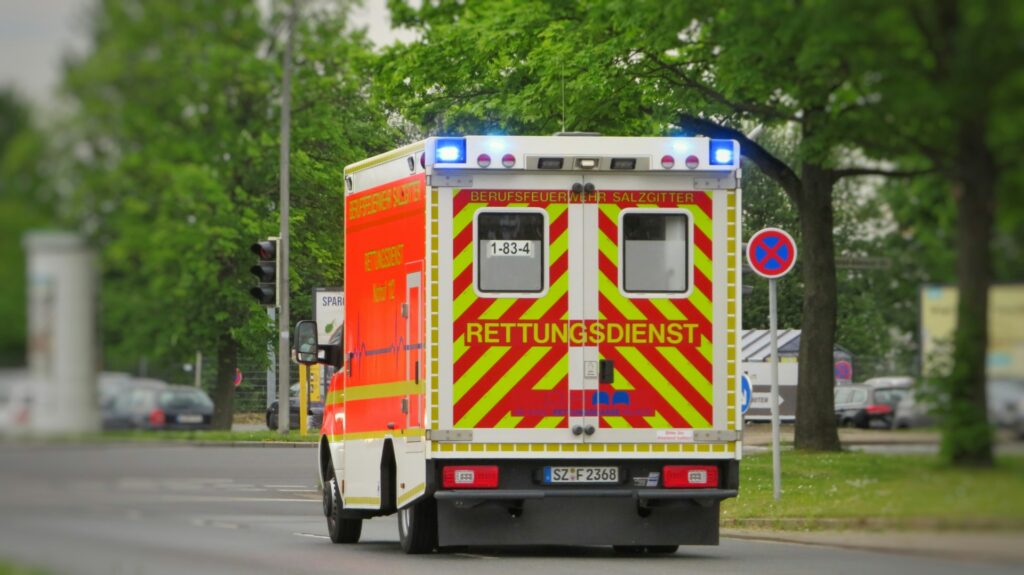
In Germany, the main emergency number is 112, which connects you directly to ambulance, fire, and police services. Operators can usually provide support in English, but knowing a few basic German phrases can be helpful. For urgent but non-life-threatening medical issues, you can also call 116 117 to reach the on-call medical service.
Emergency care in Germany is known for its high quality and efficiency. Ambulances are well equipped, and response times are generally fast, particularly in urban areas. Hospitals are modern and staffed with highly trained medical professionals, ensuring prompt treatment on arrival.
For expats, it’s important to always carry proof of health insurance, as you may be asked for this at the hospital. If you are covered under the public system, most emergency care costs will be billed directly, but private insurance holders may need to pay upfront and claim reimbursement later. Keep key emergency numbers stored in your phone and learn your local hospital’s location in advance to feel prepared in case of an emergency.
Vaccinations in Germany
There are no mandatory vaccines for entry into Germany, but some are highly recommended:
- MMR
- Tetanus, diphtheria and whooping cough (Tdap)
- Hepatitis A and B
- Rabies
- COVID-19
Common health risks in Germany
In general, health risks in Germany are lifestyle-related rather than due to infectious diseases. Smoking, alcohol consumption, and obesity rates are relatively high. To stay healthy, expats are encouraged to follow a balanced diet, limit alcohol, avoid smoking and maintain an active lifestyle.
Tips for staying healthy in Germany

For expats living in Germany, here are a few tips to help you stay healthy whilst in the country.
- Keep active. German people love the outdoors, so embracing that culture by cycling, hiking or skiing can help maintain your fitness.
- Stay hydrated. Certain areas of Germany can get very warm during the summer months.
- Register with a GP and ensure you have appropriate health insurance in place (expat, GVK, PVK)
- Keep your vaccinations up to date.
- Remember good hand hygiene.
- Learn key German phrases that may help you in a medical emergency.
Useful resources
- Emergency number for ambulance services: 112
- German Ministry of Health:https://www.bundesgesundheitsministerium.de/en
- Germany expat forums:
Disclaimer
For informational purposes only
The content in this guide is for general informational and educational purposes only. It does not constitute legal, financial, tax, or medical advice.
Accuracy and currency
Regulations and laws change frequently. While we strive for accuracy, we make no guarantees that this information is complete, accurate, or up to date.
No reliance & professional advice
Do not rely on this guide as a substitute for professional advice. Always verify requirements directly with official government sources or qualified advisors before making decisions.
Limitation of liability
To the maximum extent permitted by law, Expatriate Group accepts no liability for any loss, damage, or errors arising from reliance on this information.